Own the AI layer: how Beaumont Property runs on Agent360

How one of Sydney's most established commercial property and strata groups went from manual admin and ungoverned AI use to a governed agentic platform it owns: live across all six businesses, eight weeks after a standing start.
Where we started: the appetite for owned AI
Beaumont Property Group is one of Sydney's most established commercial property and strata groups: four brands, 3,000+ managed properties and more than 23,000 strata lots across NSW, built over four decades of family-owned growth. The group had grown by acquisition, and it ran on 14 specialised systems that didn't talk to each other. Experienced professionals spent much of their week moving data by hand between the systems.
The cost showed up everywhere: days each week absorbed by payment runs, hours every day on reconciliation and reporting, database upkeep eating hours per agent every week, and compliance work living in and around spreadsheets.
But the appetite was not the problem. Like almost every business right now, staff were already using public AI tools on their own, outside any governed environment, and the ask from inside the business was clear:
"Everyone seems to rave about it. I just want to have a standard product. I don't want everyone using their own." Beaumont team member, whole-of-staff survey
Beaumont's own whole-of-staff survey (87 responses, a 75%+ response rate) put numbers to it: 98% wanted more AI training, 60% already used AI weekly or more, and 76% rated AI tools useful.
Adoption was never going to be the hurdle. The job was to give people a governed, connected, trustworthy version of what they were already trying to do, over Beaumont's own data, with the guardrails a property group needs before it puts client information into an assistant.
What we delivered
Agent360: a governed agentic platform over Beaumont's connected systems, spanning CRM, property management, strata and Microsoft 365, with a workspace assistant. Built in waves, human-in-the-loop by design, with each person seeing only their own data.
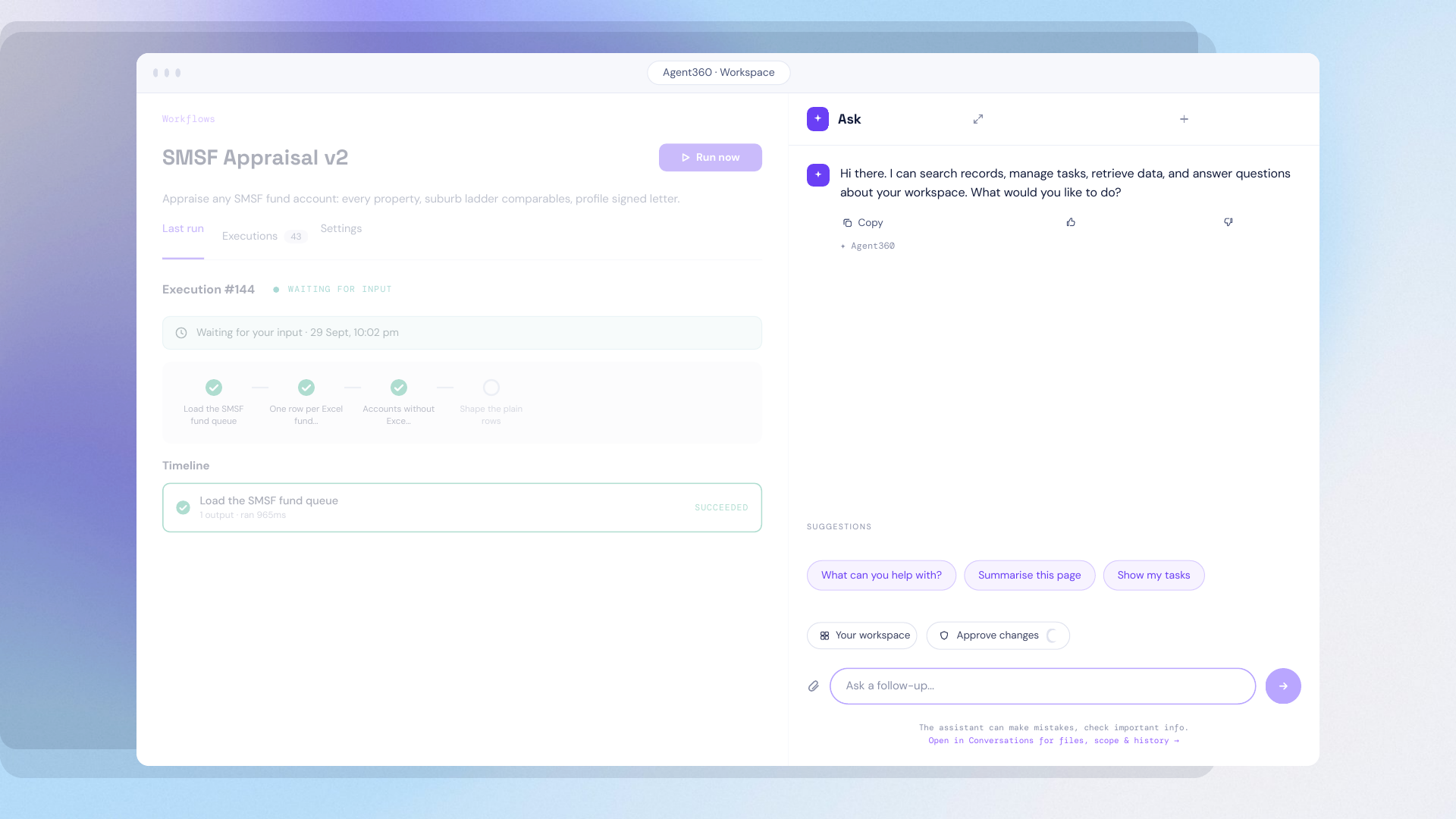
Wave 1 put five workflows into pilot: SMSF Appraisal, Sales and Leasing Meeting Prep, PM Meeting Prep, Document Filing, and Client Relationship Health, on top of connected email, a knowledge base now in daily use, and in-platform sending.
.png)
It became routine, fast
Weekly conversations roughly doubled across the first month of rollout as the second wave of the team came on, then settled at a consistent 1,300 to 2,200 a week: the signature of a tool that has become part of the job rather than a novelty. Usage clusters Tuesday to Thursday, 9 to 4: the working week, not after-hours curiosity. There's a committed daily core spanning finance, sales, property and strata, and new names join every week. And it's getting cheaper as it goes: cost per conversation is down about 60% as caching took hold.
Real work is flowing through it
- The entire SMSF appraisal book is loaded into the workflow and generating appraisals for review. A client base that used to live in one person's head and spreadsheets is now a governed, repeatable process.
- 20,000+ emails a week are processed in the background: connected, classified, and made searchable, with no human effort.
- 36 meeting-prep packs produced across property management and sales and leasing.
.png)
The moment that made the case
The clearest win came in Sales and Leasing: a vendor campaign report that had resisted months of conventional build effort came back from the assistant in a couple of minutes, with agent commentary generated automatically.
"Already a better graph than what we previously had." Sales and Leasing, Beaumont Property
The baseline it replaced: no standard vendor report had existed at all.
In their words
"The first thing I need to know is what's going wrong, what are the urgent matters I need to take care of right now. It's really good at that." Email triage
"This is a huge thing for me, I'm so excited." Strata operations
"That's already a vast improvement to what we are currently using." Strata administration
"I've been using the conversations quite a bit. It's working really well." Admin, HR and finance
The consistent lesson: what converts a user isn't a training session, it's one real query on their own data. A new sales hire was the second-heaviest user on the platform two days after joining.
The challenges we faced
A fair account includes the parts that weren't smooth. Three matter:
1. Reliability before rollout
Document Filing drew the strongest excitement of any workflow, and its first independent bulk runs showed exactly why every workflow starts in pilot: issues surfaced there that would never have been acceptable in production. That is the release discipline working as designed. On this platform, a workflow earns its way into production on reliability, not enthusiasm.
2. Consistency where the stakes are highest
Early report generation could vary from run to run, which matters acutely for financial reporting. Deterministic, repeatable generation is now a defined priority and the foundation for a reusable report builder.
3. Adoption is the quiet risk, and the real work
Completing onboarding isn't the same as using the tool, and usage varies across any rollout. Getting from active to genuinely embedded is a change-management job, not a technical one, and it's why the one-real-query-on-your-own-data lesson has been built into how every new user is brought on.
None of these are reasons the platform isn't working. They're the honest edges of a platform that is.
What's next for Beaumont
The most telling result isn't any single number: it's how far Beaumont's ambition has outrun the original plan. Wave 2 is under selection with executive leadership, ranked against a clear test: what removes the most manual load first. The mapped pipeline runs to 51 workflows, and the teams running wave 1 are asking to take it wider.
.png)
Why it's working
- Value before workflows: connecting real data and letting people query it drove adoption ahead of any feature.
- Real champions, honestly heard: champions in every function, whose criticism is captured as faithfully as their praise.
- Governed and safe: human-in-the-loop, least-access, nothing sent or filed autonomously. The conditions under which a property group will actually trust AI with its own data.
- A platform, not a point solution: every workflow builds shared foundations, which is exactly why Beaumont now wants to run the business on it.
Want to own your AI layer?
Agent360 gives organisations a governed agentic platform over their own systems, knowledge and data. If Beaumont's story sounds like your operation, talk to us.
Note: Product screens are illustrative recreations of Agent360 as deployed at Beaumont Property. Workflows, features and metrics shown are real; some details are simplified or anonymised for privacy.