Five layers of human-agent interaction
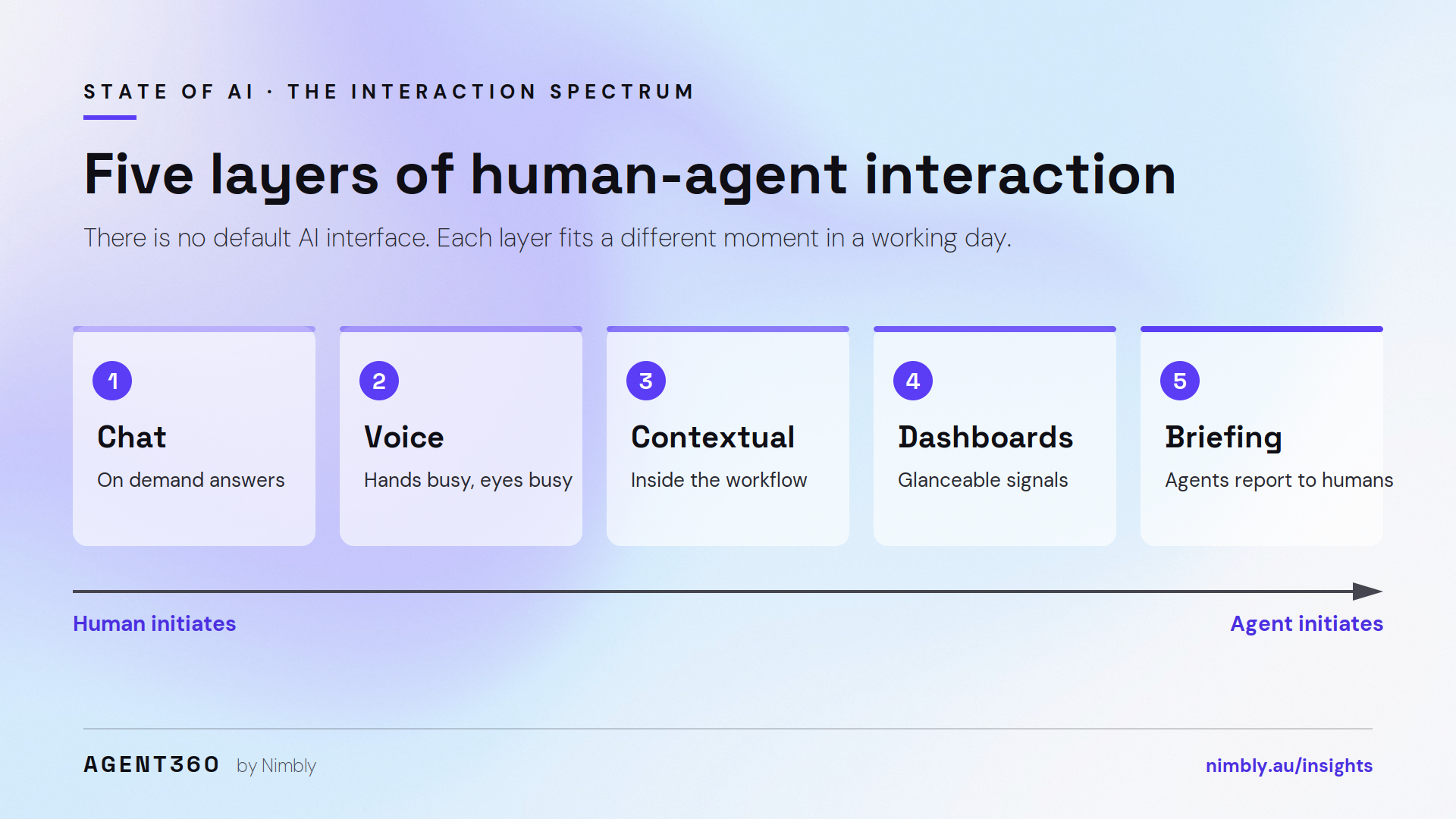
Chat is the floppy disk of AI: the interface we all reached for first, not the destination. Building Agent360 taught us there are five layers of human-agent interaction, each fit for a different moment in a working day. Here's the spectrum.
We are living through the most interesting era of human and machine interaction since the graphical interface replaced the command line. And, just as it did then, the industry has collapsed a rich design space into a single convention. Ask most people what an AI product looks like and they will describe the same thing: a text box, a blinking cursor, an answer streaming in.
Chat earned that position honestly. It was the fastest way to expose what language models could do, and for genuinely open-ended work it remains a powerful tool. But the first interface is rarely the right interface for everything. Chat is the floppy disk of this era: the thing we all reached for first, not the thing we were heading toward.
The mistake is not using chat. The mistake is defaulting to it.
Building Agent360 has taught us that AI-native products need a spectrum of interaction patterns, each fit for a different kind of moment in a person's working day. Here is the spectrum as we have come to understand it, running from interactions humans initiate to interactions the system initiates on their behalf.
Chat: conversational, on demand, and honest about its limits
Chat is where you go when you know something is knowable but you do not know where it lives. Our own Agent360 Assistant exists for exactly this: ask the business a question in plain language and get an answer grounded in your operation's own knowledge, with the sources one tap away.
But great chat design starts by respecting a hard truth of human factors: humans do not know what they do not know. A blank prompt box transfers the burden of knowing what to ask onto the person least equipped to know what the system knows. Every prompt composed is a small interaction cost, and those costs compound across a working day. That is why chat inside Agent360 is scoped, suggests what it can answer, and carries the context of wherever the person already is.
Chat is a brilliant instrument for the open-ended question. It is a poor default for everything else.
Voice: the natural extension for hands-busy, eyes-busy work
Voice is chat freed from the keyboard, and it matters most exactly where keyboards fail: the technician with gloves on, the nurse mid-round, the site manager walking a job. For on-the-go operations, speaking a job note or asking for the next stop is not a novelty; it is the difference between knowledge being captured and knowledge evaporating.
And as AI moves into glasses, watches, pins and badges, voice becomes the primary interface of the wearable era: the screen stops being where work happens. The longer arc here points toward ambient interaction, where the system listens for the moments that matter and the explicit request disappears entirely. We are deliberate about the guardrails that future needs, but the direction is clear: the less a frontline worker has to stop working to talk to the system, the more the system gets used.
Voice is how AI leaves the screen. The wearable era will run on it.
Contextual: intelligence where the work already lives
The workhorse layer. UX practice has a principle worth naming here: adjacency. Information and actions belong next to the thing they concern. The recommended technician belongs on the roster. The margin warning belongs on the quote. The compliance flag belongs on the job card. Not in a separate destination the team must remember to visit.
Adjacency is what collapses friction. When the recommendation appears inside the screen where the decision is already being made, the interaction cost rounds to zero and adoption stops being a change-management program. This is also where exceptions surface: the system acts on the routine and raises its hand, in place, when something does not match. A chat window beside the work cannot do this. Intelligence inside the work can.
Information and actions belong next to the thing they concern.
Dashboards: the end of the export ritual
Every operations leader knows the ritual: export to a spreadsheet, wrangle, reformat, circulate, repeat next week. Dashboards in an AI-native platform exist to retire that ritual. Not walls of charts, but the metrics that matter, maintained live, designed to be glanceable: the green that says all is well and the red that demands human attention.
Glanceability is a discipline, not a decoration. A good operational dashboard answers one question in under three seconds: does anything here need me? If the answer is no, the person gets their morning back. If it is yes, the red thing is one tap from its cause. That is the whole job.
Glanceability is a discipline, not a decoration.
The briefing layer: how agents report to humans
The newest layer, and the one we think matters most. A dashboard presents information; a briefing communicates. As agents take on real work, humans need something no traditional interface provides: a communication layer where the system accounts for itself. Where things are. What was done overnight. What is blocked. The critical actions waiting on a human call, and the next best thing to do now.
Think of it as the difference between reading instruments and getting a handover from a trusted colleague at shift change. The briefing layer is agent-to-human communication designed around a person's actual day: it opens the morning with what matters, closes the loop on what was delegated, and never buries the one decision that needs judgement under twenty that do not.
This is also where our humanist convictions become product. The purpose of agents doing the routine is not fewer humans; it is humans spending their day on judgement, relationships and exceptions, with a system that briefs them like a capable chief of staff. AI for good is easy to say. A briefing layer that demonstrably gives people their day back is what it looks like in action.
A dashboard presents information; a briefing communicates.
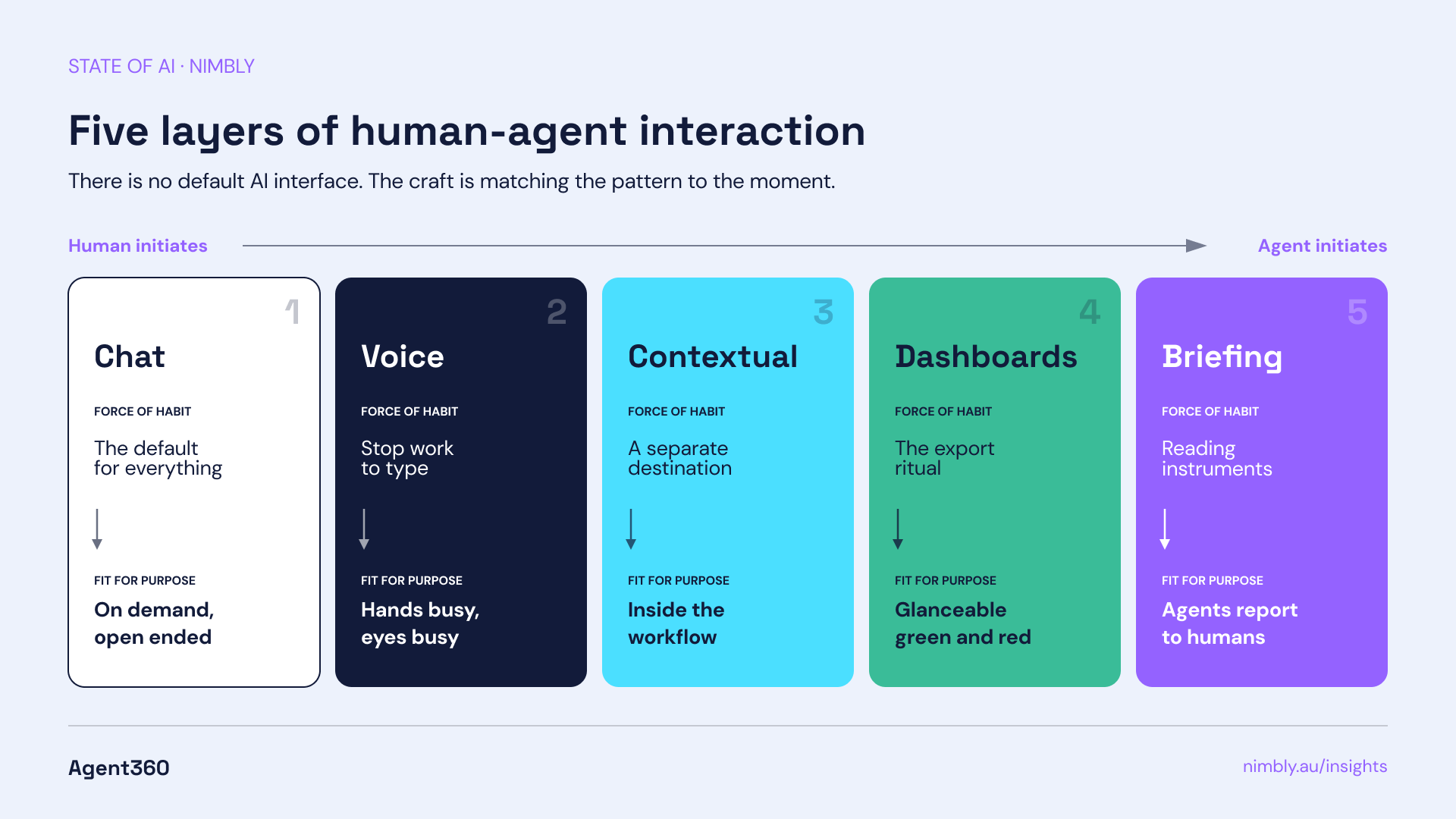
Fit for purpose, not force of habit
Five layers, one logic. Chat and voice serve the moments humans initiate. Contextual intelligence and dashboards serve the moments work initiates. The briefing layer serves the relationship itself: the ongoing conversation between people and the agents working alongside them. None of these is the AI interface. Each is the right interface for a kind of moment, and the craft is matching the pattern to the moment.
So when you evaluate an AI product, including ours, ask one question of every capability: why this interaction pattern for this moment? If the answer is “because chat was easiest to ship,” you are looking at a floppy disk. If the answer traces back to how your dispatcher, technician or finance lead actually spends a Tuesday, you are looking at something designed for humans.
Not sure where AI genuinely fits your operation? Our free diagnostic takes a few minutes and gives you the answer on the spot at nimbly.au/ai-compass-fit.